
“A Theatrical Event is qualified by someone doing something, ostentatiously enough to be distinguished from everyday life, and someone who observes the doer, and acknowledges that what is being done is different.” (Theatrical Events, Rodopi 2004: 11)
KEYWORDS
Audience research, perception, performance analysis, theatre sociology
Convenors
Smadar Mor, Tel Aviv University: smadarmo@tauex.tau.ac.il
Rikard Hoogland, Stockholm University: rikard.hoogland@teater.su.se
Keren Cohen, David Yalin College / Philipps-University Marburg: krncohen@hotmail.com
Call for papers the Theatrical Event WG.
Nafplion, Greece, 28June – 2 July 2027
Beyond Reception: New Perspectives on Audiences in the Theatrical Event
This year the Theatrical Event Working Group is celebrating thirty years of annual meetings, intensive discussions and criticism, six book publications and a special TRI issue on its way. The aspect of Theatrical Playing and its communicative variations has always been at the heart of the group’s work. The Working Group’s discussions in Nafplion will return to the concept of audiences and will be dedicated to multitude angles on the theme “Beyond Reception: New Perspectives on Audiences in the Theatrical Event”. The papers will be based on the Theatrical Event model, and members are encouraged to incorporate a variety of theoretical perspectives and analytical tools to approach the topic. We invite new participants, as well as current and former members of the group, to submit their proposals for the meeting.
The concept of the Theatrical Event includes various forms of theatre, opera or dance, as well as any communicative event in which a beholder observes an agent that seeks attention. Contributions may deal with any kind of historical or contemporary theatrical event in the broadest sense, i.e. from traditional theatre performances to installations, rituals and ceremonies, festivals, concerts, games etc. The point of departure should always be a particular event described and analysed from a specific perspective: its conventions, organisation, time and place, or the encounter between performers and spectators. In all cases, cultural and other key contexts should be taken into consideration.
Proposals may engage with, but are not limited to, the following topics:
- Directors’ and performers’ perspectives on audiences
- Audience communication during performance
- The two-way communication between stage and audience
- Inter-cultural comparative examination of audiences
- Comparative audience analysis in festivals and touring productions
- Interactive theatre audiences
- Challenging audience expectations (e.g. in repertory theatre)
- Audience and community theatre
- Audiences in educational contexts
- Audience agency
- Audience provocation
- Audiences as groups and/or individual spectators
- Audience development
- Audience participation and transformation
The working group has so far published five collective publications on different aspects of the Theatrical Event: Theatrical Events (2004), Festivalising! (2007) Playing Culture (2014), Poetics of Playing (2014), and Theatre Scandals (2020). Two further publications are currently underway: the forthcoming Taking Centre Stage: Theatre for Young Audiences, Theatre with Students and Amateur Theatre (in press/2027) and Theatrical Event: Policy, Power, and the Democratization of Performance, special issue of Theatre Research International special 52 no. 3 (autumn 2027).
We welcome proposals from all parts of the world. Contributors are encouraged to familiarise themselves with the books the Working Group has published (see below), in particular some of the theoretical and methodological concepts and models which were presented in the group’s various publications.
You are welcome to submit an abstract (250 words max.) through the IFTR Website. In order to submit your proposal, please join the IFTR or renew your membership. Abstract submission opens: 1 October 2026, deadline for abstract submissions: 2 November 2026. Notification of acceptance: 21 December 2026.
Once the abstract has been accepted, the first version of the paper (no more than 3-4000 words, with a clear idea but ample room for revisions and additions), should be distributed among the group’s members about 3 weeks before the meeting. Following a brief presentation (10 minutes), our discussions during the conference will primarily focus on providing constructive feedback, as all participants are expected to have read the papers in advance. This process aims to help authors refine their ideas and further develop their drafts into final texts.
The convenors will be happy to answer any questions.
About the Theatrical Event Working Group
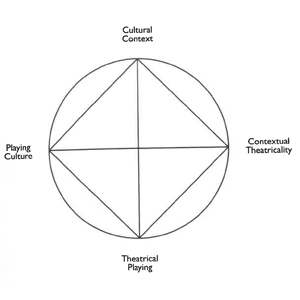
The Theatrical Event Working Group was established in Puebla, Mexico in 1997. The group’s mission is to rethink and reconsider the fundamental definitions, limitations and structures of the Theatrical Event. It has adopted a series of methodological criteria and their interconnections to discuss any theatrical event:
- Cultural contexts
- Contextual theatricality
- Theatrical playing
- Playing culture
The group accepts discussion on subjects that concern happenings within a theatre, as well as events that occur outside a theatre but bear theatrical characteristics, which can be analysed through the lens of theatre studies.
The Theatrical Event working group functions by deciding upon a theme and circulating papers pertinent to that theme before the annual IFTR conference, which are read by all participants. Anyone who is a paid-up member of the IFTR can participate in the working group, either by submitting a paper, or by attending the sessions and listening to the discussions. During working group sessions, a short presentation of each paper is given, followed by discussion of the whole group.
It will be an open call that invites paper topics that concern any of the four points of the Theatrical Event.
Current Projects
The Theatrical Event book project Taking Center Stage. Theatre for Young Audiences, Theatre with Students and Amateur Theatre will be published in spring 2027. Book launch will hopefully take place at the IFTR conference in June 2027. A special issue of TRI (52:3), Theatrical Event: Policy, Power, and the Democratization of Performance (automn 2027)
Completed Publications/Outputs
Theatrical Events. Borders, Dynamics, Frames, edited by Vicki Ann Cremona, Peter Eversmann, Hans van Mannen, Willmar Sauter and John Tulloch. Amsterdam: Rodopi, 2004. This book contains theories and methodologies that allow the reader to understand the concepts behind what is meant by ‘theatrical event’. Details here.
Festivalising! Theatrical Events, Politics and Culture, edited by Temple Hauptfleisch, Shulamith Lev-aladgem, Jacqueline Martin, Willmar Sauter and Henri Schoenmakers. Amsterdam: Rodopi, 2007. Details here.
Playing Culture. Conventions and Extensions of Performance, edited by Vicki Ann Cremona, Rikard Hoogland, Gay Morris, Willmar Sauter. Amsterdam: Rodopi, 2014. Details here.
Poetics of Playing. Fictionality, Reality and Playing in between, Nordic Theatre Studies, Vol. 26, No. 1, 2014. Edited by Anneli Saro, Ulla Kallenbach, Rikard Hoogland.Open Access publication.
Theatre Scandals. Social Dynamics of Turbulent Theatrical Events, edited by: Vicki Ann Cremona, Peter Eversmann, Bess Rowen, Anneli Saro, Henri Schoenmakers. Leiden/Boston: Brill Rodopi, 2020. Details here.
Taking Centre Stage: Theatre with/for Amateurs, Students, and Young Audiences. Leiden and Boston: Brill, Themes in Theatre Series, forthcoming 2027. Edited by Keren Cohen, Vicki Ann Cremona, Peter Eversmann, Rikard Hoogland and Smadar Mor.