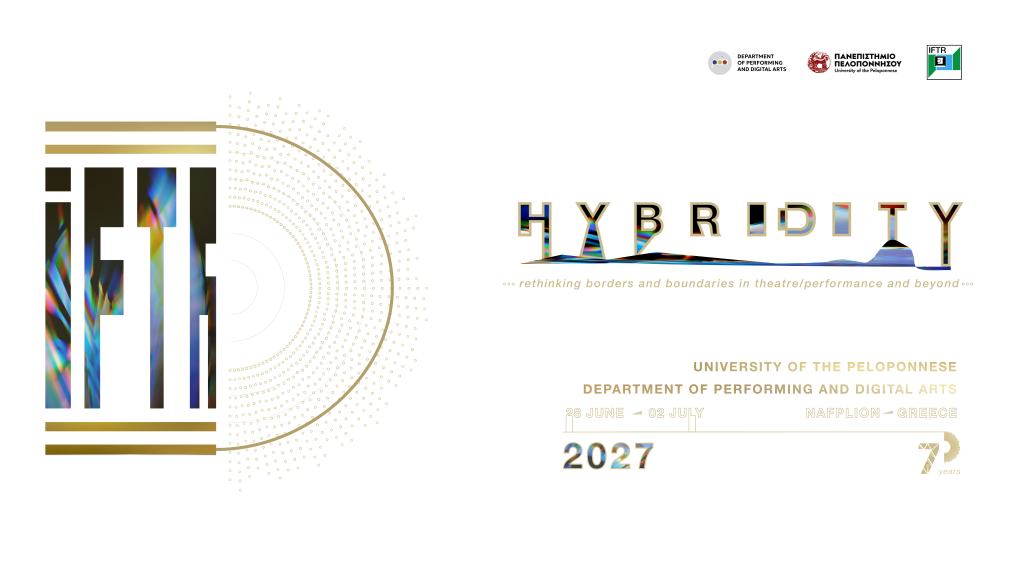
Hybridity
Rethinking borders and boundaries in theatre/performance and beyond
Celebrating 70 years of IFTR (1957-2027) @Nafplio
The term ‘hybridity’ was originally used in botany to describe the crossbreeding of different plants, and was later adopted and distorted by nineteenth-century imperial and racist ideologies to marginalize individuals of mixed race. In the twentieth century, it was re-appropriated by social and cultural critics such as Bakhtin, who asked what hybridization could mean in the sphere of language, and Bhabha, whose proposed the ‘Third Space’ as a liminal site of cultural encounter between the colonizer and the colonized. Such re-configurations have received renewed attention in the twenty-first century in multiple contexts, such as the rethinking of post-globalization borders and boundaries, the rise of digitalization in the post-internet era, and more.
‘Hybridity’, as a porous site of exchange, also expresses the nature of theatre and performance. Theatre has always been a hybrid medium that includes disparate creative disciplines, such as music, dance, opera, poetics, choreography, scenography, architecture, cinema, media art, visual art installations and so on – while also operating as a form that crosses languages, cultures, and identities. Performing hybridity – whether through conjoining/disjoining, constructing/deconstructing, synergizing, fusing or blending of cultures, forms, mediums or technologies – offers new ways of thinking about, making, and participating in theatre. It also provokes and encourages artists, audiences and scholars to question assumptions about identity, language, genre, space, time, borders, culture, live presence, and technology. The theme thus has relevance and urgency, especially in our era of transition from pre-twenty-first century media and cultures to new organizational forms and technologies.
Hosted by the Department of Performing and Digital Arts, University of the Peloponnese (Nafplio, Greece), the conference will take place in the city centre of Nafplio, celebrating theatre as a vibrant social function of the city. Located near the ancient theatres of Argos and Epidaurus, Nafplion offers a unique setting in which contemporary debates about performance, technology, and identity intersect with the rich theatrical heritage of the region. So, the theme of ‘hybridity’ also responds to Greece’s unique geographical and historical features, serving as a powerful symbol of in-between/betwixt spaces, where multiple cultural and political forces meet, clash, and coexist.
The Call for Papers can be found here.
If you wish to present a paper as part of a Working Group, please visit the respective Working Group page to see a Working Group-specific CfP.
Abstract submission will be done on the Conference Website by clicking on ‘Abstract Submission’ above. This will be visible from 1 October 2026.
Please note that you have to be a member of the IFTR to submit an abstract or register for the conference. To join IFTR, click on ‘Register’ on the Home page.
Membership registration opens: 1 October 2026
Abstract submissions open: 1 October 2026
Deadline for abstract submissions: 9 November 2026
Notification of acceptance: 21 December 2026
Accommodation discounts: 1 January – 14 February 2027 (Please book accommodation as soon as possible, because Nafplio is a very popular tourist destination)
Note: IFTR2027 Nafplion is an in-person, on-site conference. There will be no opportunities for online, virtual attendance or participation unless otherwise pre-arranged with the conference organisers.
Visit the Conference Website for conference details including accommodation and travel information.